
August 7-9, 2023

- About
- Important Dates
- Online Presentation
- Abstract Submission & Presentation Types
- Themes/Topics
- Registration
- Schedule Overview
ABOUT THE CONFERENCE
SITE Interactive is announcing a bold new approach to the SITE Interactive conference for 2023. What’s new about this year’s SITE Interactive? This year’s SITE Interactive is will focus on a highly practical experience. The focus of SITE Interactive is to bring people together with a greater emphasis on collaboration than ever before. We are also introducing new abstract submission types, presentation types, and an extremely reduced registration fee!
NEW for 2023! Register for SITE Interactive 2023 Online and receive 20% of your SITE 2024 Las Vegas registration. Save up to $120 on SITE 2024!
We would like to highlight the numerous benefits of attending the SITE Interactive specifically tailored:
FOR STUDENTS
This conference offers an invaluable platform for you to engage with leading experts, researchers, and practitioners in the field. It provides a unique opportunity to showcase your work, gain valuable feedback, and explore potential collaborations with professionals who share your interests. The conference’s emphasis on collaboration and interactive sessions encourages meaningful networking and mentorship opportunities, enabling you to build connections and expand your professional network. Additionally, attending SITE Interactive 2023 will expose you to cutting-edge research, best practices, and innovative approaches, enhancing your knowledge and understanding of the field. Join us to enrich your graduate studies and embark on a rewarding journey of growth and learning.
FOR TEACHERS
By participating in this conference, you will have the opportunity to engage with a diverse community of educators, researchers, and technology experts, all focused on enhancing instructional practices through technology. The conference offers a platform for you to share your own experiences, innovative teaching strategies, and best practices with a global audience. Attendees will gain valuable insights from keynote interactions, theme conversations, and panel discussions, providing inspiration and fresh ideas to implement in your classrooms. The collaborative environment encourages meaningful dialogue, allowing you to connect with like-minded professionals, expand your professional network, and establish long-lasting partnerships. Moreover, SITE Interactive 2023 will expose you to the latest technological advancements and educational tools, empowering you to create engaging and impactful learning experiences for your students. Don’t miss this incredible opportunity to gain new perspectives, discover innovative approaches, and enhance your teaching practices.
FOR HIGHER EDUCATORS
The SITE Interactive Conference 2023 is meant to benefit both early career and late career faculty in higher education. This conference offers a unique platform for you to engage with fellow educators, researchers, and professionals from around the world. It provides an excellent opportunity to present your research, share your expertise, and receive valuable feedback from a supportive community. Participating in keynote interactions, theme conversations, and collaboration activities will expand your knowledge, challenge your thinking, and inspire innovative approaches in your teaching and research. The conference’s emphasis on collaboration and networking will enable you to forge connections with colleagues, establish collaborative partnerships, and explore potential interdisciplinary collaborations. Additionally, SITE Interactive 2023 will expose you to cutting-edge trends, emerging technologies, and best practices in educational technology and teacher education. Whether you are an early career faculty member seeking mentorship and guidance or a late career faculty member looking to share your wisdom and contribute to the field, this conference offers a valuable platform for professional growth, knowledge exchange, and advancing your career.
NEW TIME AND SCHEDULE
To better work around your busy life, this year’s SITE Interactive Conference will be in the summer instead of the fall, and it will be three half days instead of two full days!
- August 7th from 9AM EDT to 2PM EDT
- August 8th from 1PM EDT to 7PM EDT
- August 9th from 4PM EDT to 7PM EDT
SCOPE
The SITE Interactive Online Conference invites proposals from the introductory through advanced levels on topics related to best practices regarding the use of information technology in teacher education, and improving instruction and mentoring using information technology in:
- In-person, online, and/or blended environments
- Undergraduate and graduate preservice and in-service Teacher Education
- Faculty & Staff Professional Development
- K-12 and higher education
Proposals should focus on improving practice in innovative ways.
ABSTRACT PROPOSALS NOW ACCEPTED
This year’s SITE Interactive will also introduce new types of proposals. Instead of focusing on completed (or nearly completed) projects and the dissemination of information, this year’s conference is going to focus on leading conversations around big questions in the field related to research, teaching, or other professional practices! We have highlighted these new presentation types below.
Abstract Submission & Presentation Types Details Here:
https://site.aace.org/online/interactive-presentation-types/
This year’s SITE Interactive Conference will feature:
- Keynote Interactions: Come ask questions and get answers from leaders across the fields of educational technology and teacher education! The conference will host speakers leading discussions about a host of interesting topics.
- Theme Conversations: This is your opportunity to share your ongoing projects and big questions with other conference attendees. If you are seeking guidance, feedback, or collaboration on an ongoing project – these sessions are for you!
- Panels: This is a way to share the efforts of an ongoing collaborative project, gaining attention, and receiving feedback to move the project forward.
- Collaboration Activities: Τhese sessions specifically focus on papers, projects, or other works-in-progress and provide participants with opportunities to contribute to the ongoing work.
- Virtual Posters: Much like traditional poster sessions, these sessions are the only way at SITE Interactive to share completed projects or research in an asynchronous setting.
MORE ABOUT SITE
SITE is a society of the Association for the Advancement of Computing in Education (AACE).SITE, known as the ‘The Friendly Society’, is unique as the only organization which has as its sole focus the integration of instructional technologies into teacher education programs. SITE promotes the development and dissemination of theoretical knowledge, conceptual research, and professional practice knowledge through conferences, books, projects, and the Journal of Technology and Teacher Education (JTATE). Learn More »
SITE is unique as the only organization which has as its sole focus the integration of instructional technologies into teacher education programs. SITE promotes the development and dissemination of theoretical knowledge, conceptual research, and professional practice knowledge through conferences, books, projects, and journals such as the Journal of Technology and Teacher Education (JTATE).
SITE is the premiere international conference in this field and annually attracts more than 1,300 leaders in the field from over 60 countries.
The SITE Conference is designed for: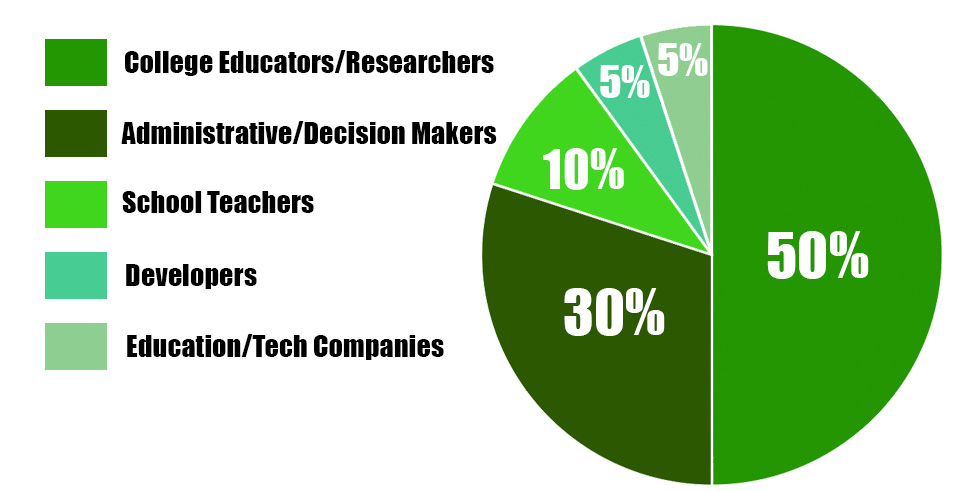
- Teacher educators in ALL disciplines
- Computer technology coordinators
- K-12 administrators
- Teachers
- Curriculum developers
- Principals
- All interested in improving education through technology
IMPORTANT DATES
- Conference: August 7-9, 2023
- Call for Submissions Due: July 5
- Reviews due: July 17
- Decisions due: July 20
- Authors Notified: July 21-31
- Early registration and confirmation: August 4
ONLINE PRESENTATION

SITE Interactive 2023 brings a new approach to conferences. An approach that focuses on works-in-progress and questions related to professional practices of any kind in educational technology and teacher education – research, teaching, design, service, promotion and tenure, funding, etc. SITE Interactive is a conference for people to come together to share and/or discover opportunities for collaboration. It is a conference for interacting more deeply with those who share your professional interests.
The online format of the conference will allow participation by those who otherwise would be unable to attend due to funding, time constraints, or travel restrictions while still providing the same validity (publication, certification, etc.) as the traditional face-to-face conference. The online format will also provide additional opportunities to interact with session presenters and participants.
SUBMISSION & PRESENTATION TYPES
ABSTRACTS ARE NOW BEING ACCEPTED FOR ALL PROPOSALS!
Details & requirements found here.
- Theme Conversations
- Panels
- Collaboration Activities.
- Virtual Posters
Abstract – Include an abstract, 550 words minimum up to 2 pages max, for your proposal that provides detail of the session, what will be covered, who it is intended for, how it will be presented, etc. All abstracts will be reviewed for acceptance. Accepted abstracts will be invited to present. Accepted abstracts are also invited submit a abstract paper submission for review to be accepted for presentation. *Abstract submissions are required to be entered in both the abstract field of the submission form as well as uploaded in .docx format as a ‘proposal file’ for review.
After submitting your proposal by the deadline, use the menu at Submission and select “Add Files to Submission” to upload your PowerPoint file in PPT or PPTX format (without audio or video). Also, at least one author must confirm by registering by the Confirmation Deadline.
The Conference Review Policy requires that each abstract proposal will be peer-reviewed by at least two reviewers for inclusion in the conference program.
REGISTRATION

NEW for 2023! Register for SITE Interactive 2023 Online and receive 20% off your SITE 2024 Las Vegas registration! Save up to $120 on full price registrations.
| Regular Interactive Registration | $65 |
| K-12 Teacher Registration | $50 |
| Student Registration* | $50 |
* To qualify for the student rate, you must provide proof of full-time student status at the time of registration.
GROUP DISCOUNT: If your university or institution sends 10 or more attendees, each attendee will receive 10% off their individual rate. Please email conf@aace.org to register your team fo 10!
Your Registration Includes
- Capability to interact with your session’s participants prior to, during and after the event.
- Technical support for online presentation platform.
- Access to Keynote & Invited Speaker talks.
- Access to all conference session discussions.
- Participation in keynote conversations.
Cancellation/Refund Policy:
Registrant requests for refund of registration fee will only be considered if a written request is sent postmarked by the early registration date, as shown above. No refunds can be issued for requests postmarked after July 1, 2023. Refunds are subject to a $25 cancellation fee; there are no refunds for non-attendance.
THEMES/TOPICS
- Decolonized, Inclusive, and Empowering: The role of Educational Technology
- Education is socially-constructed and, as such, has the potential to improve as well as reflect society. What power structures drive education? How does that power gain influence in education? How does power leverage educational technology to impact education? How can power be inclusive in educational arenas? How can education be used to scrutinize, broaden and change existing powers, including their decolonization? How can education, particularly through education technology, empower learners to speak to power and transform it?
- Beyond Emergency Remote Teaching: Supporting Learning and Engagement in Online and Blended Environments
- Moving on from remote learning, this theme looks to understand some of the emerging approaches to the use of online learning in schooling now. This may include new school structures, policies, or pedagogies that afford online learning opportunities as core practice. What are the possibilities for combining at school and home learning days? What are new pedagogical approaches? How is hybrid teaching being further refined? What are current practices and models for simultaneously teaching students in the physical classroom and students online? What professional development models are being used or developed to help teachers teach online? How can we design online and blended environments to engage students more efficiently in community-based learning and asset mapping? Fundamentally, what are the gains we can take forward from online learning experiences and how do we do this to leverage and advantage online and blended learning in schools? The recent events give professionals an opportunity to learn from necessary changes, as well as leveraging lessons learned to optimize future education.
- The Big Picture: Educational Technology Policy, Ethics, and Big Data
- As new advances are made in educational technology, our field needs both scholars and practitioners who can lead the way in monitoring how policy, ethics, and big data impact society. Learning management systems, educational apps, attendance and behavior tracking all integrate into our educational systems more than ever before. How do educators and leaders select and utilize these programs? What considerations do we all need to take to ensure our faculty, students, families, and institutions are safe? How should analytic data be monitored? Who should have control over what data is collected and who has access to that data? What inequities can big data surface, address, or exacerbate and how do policies need to consider the implications of its collection/use? This theme will explore any and all of these questions with a focus on communication, advocacy, and ethical decision-making. Submissions should focus on the potential societal impact of practices related to educational technology policy, ethics, and big data.
- Frontier Technologies: XR, AI, Makerspace, and More
- Frontier technologies have the potential to support learning and teaching in a variety of content areas and contexts. We ask for submissions that focus on how frontier technologies are used with learners? What are the advantages and challenges in this space? What considerations need to be made related to cognitive load with XR? What are some pedagogical considerations that can be suggested by an empirical study? What technology integration framework works best? What work has been done in this space that can inform future practice in our classrooms? Are there key features that can help in instructional practice? What are some learning gains in using makerspaces? What critical questions come to mind when dealing with AI? How is the use of AR/VR helpful in teacher preparation? What are some accessibility and technical issues to be aware of? As you can see the possibilities are endless with frontier technologies. We ask for you to share in a discussion of the future of education technology and discuss the next frontier of education.
- Developing the Profession: Growing in Leadership, Academia, and Teaching Practice
- The theme of “Developing the Profession: Growing in Leadership, Academic, and Teaching Practice Leadership Team” centers on the nurturing and mentorship of practitioners entering the classroom along with emerging scholars launching careers in academe. Inherent in this theme is community, in that our work focuses on the sharing of information and best practices for professional success across contexts.
Previous SITE Online Participant Testimonials

Special thanks to the SITE Interactive Planning Committee:
- Cecil Short, SITE Interactive Program Chair Program Chair
Leadership Team Members